
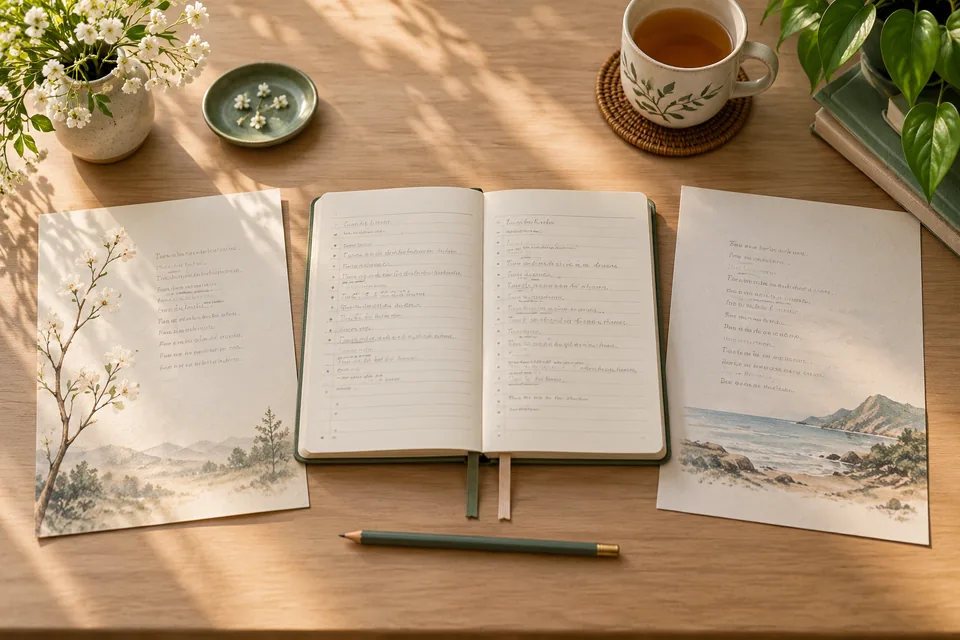
This guide shows how to compare theme, method and effect in the same paragraph, with two original short poems written by our teachers.
What a poetry comparison asks for
Comparing two poems means reading them against each other. You argue about how they treat a shared subject, such as the same theme, mood or experience, in two different ways.
You do not describe each poem in turn. You hold them side by side, so every point about one is measured against the other. Where do they agree?
Where do they differ? What does one poem’s method show about the other? The useful ideas come from the space between the poems.
Comparison appears in the Literature route, on set poems and on unseen pairs. It builds on everything you know about reading a single poem. Task wording, the choice of poems and the credit differ by board and syllabus year.
We teach the current rules from each board’s official syllabus, summarised on our qualification pages. The technique below works for any pair, because it is about how to structure a comparison.
The mistake that sinks most comparisons
The most common failure is the two-essay structure. The student says everything about the first poem, then everything about the second. A hopeful “similarly” or “in contrast” is added at the end.
That is not a comparison. It is two descriptions on one page, and the reader has to do the comparing.
The fix is in the structure. Build each paragraph around a point of comparison, such as an idea, a method or an effect, and bring both poems into that paragraph. Then the comparison happens all the way through, not in a last sentence.
A method for joined-up comparison
- Find the shared ground: the subject or theme both poems treat, stated in a short phrase.
- Decide the main contrast: the biggest difference in attitude, tone or method.
- Plan paragraphs around points of comparison, not around poems, so each paragraph covers both.
- Inside each paragraph, move between the poems with real comparing words, such as “where the first lingers, the second hurries”, and support each side with evidence.
- Explain the effect on both sides. Compare what the poems do to the reader, not just which features they contain.
A worked example: two original poems from our teachers
Both short poems are our own original writing, made for teaching.
Poem A The garden my grandmother kept is a car park now neat white lines where the roses were, and nothing left to prune but the light.
Poem B They paved the old lot by the station at last, and I was glad: no more weeds, no more rust, just clean grey ground where the mess used to be.
Both poems treat the same subject: a green or wild place turned into paving. That is the shared ground.
The main contrast is attitude. Poem A mourns the loss, and Poem B welcomes it.
A joined-up paragraph might read:
Both poems watch a place being paved over, but they feel very differently about it. Poem A grieves: its roses are reduced to “neat white lines”, and the tidy phrase makes the loss feel cold and official.
Poem B feels relief. Its “clean grey ground” carries no sorrow, only quick satisfaction that the “mess” has gone.
The same act of paving is an erasure of memory in one poem and a welcome clearing in the other. The contrast in tone shows how differently each speaker values what was there before.
This one paragraph handles both poems around one idea. It is the whole method in miniature.
This is easier to improve with a teacher beside you. A paid one-hour trial starts from your child's own recent work.
Where comparisons go wrong
- The two-essay structure, described above.
- Comparing surface, not meaning. The student notes that both poems have three stanzas but ignores what they say.
- Unbalanced treatment. One poem gets rich analysis and the other a passing mention.
- Forced comparison. The student strains to find a similarity the poems do not share.
- Comparing without effect. The student lists differences in technique without saying what they do to the reader.
Building paragraphs around points of comparison, and always reaching for effect, prevents all five.
How can you practise comparing poems?
Practise pairing before you practise writing. Take any two short poems on a similar subject and write the shared ground and the main contrast in two lines. Do this with many pairs, and you will find the comparison faster in the exam, where many students stall.
Then practise one joined-up paragraph. Choose one point of comparison and write a single paragraph on both poems. Doing one paragraph at a time builds the structure without the pressure of a full essay.
Last, try a repair. Take a two-essay comparison and rewrite it so the poems are discussed together. You will see how much stronger it becomes.
How our teachers help in 1-to-1 lessons
Students usually get stuck by writing about one poem and then the other. In 1-to-1 lessons, our teachers plan the comparison with your child around points of comparison, not poems.
We then push each paragraph to bring in both texts and reach an effect. When we mark the work, we show which paragraph compared most fully and where one poem was left behind.
This skill sits at the centre of our unseen poetry and prose preparation and Literature in English tuition. Book a paid one-hour trial lesson and the teacher who would continue will mark a recent attempt with you.
For more, see the annotated model response for comparing poems and the practice tasks. Related guides are embedding short quotations and planning a literature essay.