
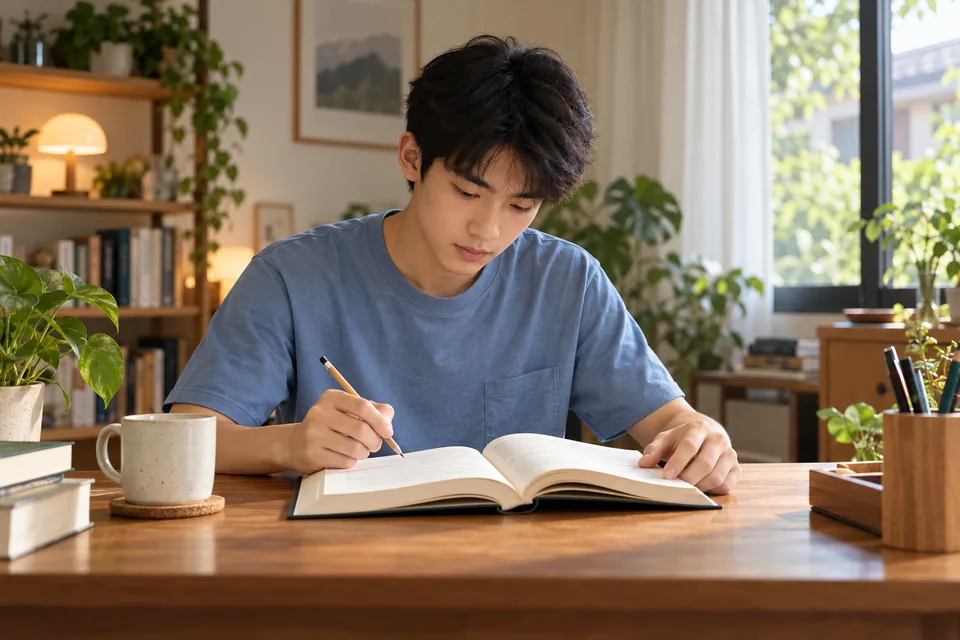
We use our own original analysis of set texts, for Cambridge 0475, Pearson Edexcel 4ET1 and OxfordAQA 9275.
Loves reading, but unsure how to turn it into marks?
Literature in English is for students who enjoy reading and want to write about it well. It is also one of the most useful IGCSEs. Close reading, structured argument and handling evidence all carry over to A-Level, university and any course that rewards clear thinking on the page.
Many students take Literature alongside First Language English. Some take it because their school requires it. Some simply love the texts.
We teach one-to-one and online, from Year 9 to Year 11. We cover Cambridge International (0475 and its 9-1 twin 0992), Pearson Edexcel (4ET1) and OxfordAQA (9275, with its route options). An experienced teacher reads your child’s essays and helps improve them lesson by lesson.
What we teach
Literature rewards close reading and arguing about a text with evidence. We cover:
- Poetry. Reading for meaning and feeling, and writing about imagery, form, sound and structure without turning a poem into technique-spotting.
- Prose. Novels and short stories: theme, character, narrative voice, structure and craft.
- Drama. How a play makes meaning on stage as well as on the page: dialogue, dramatic irony, staging and character across the whole text.
- The unseen. A repeatable method for a poem or passage your child has not studied, under time.
- Essay technique. Building an argument, embedding short quotations, analysing instead of retelling, and answering the question set.
The texts examined, the years and the paper structure come from each board’s current syllabus. Set-text lists change and belong to the board. Our set-text pages give our analysis and cite the official list, and our qualification pages carry the sourced paper details.
How we teach set texts
We help your child understand and write about their set texts. We look at the themes in a novel, why a character changes, how a poet builds an image and what a scene does on stage. Then we turn that into a focused essay.
Every practice text is our own and labelled as such. Set texts, anthology poems and past-paper passages belong to their authors and publishers, so your child should read their own copy. We quote only a short phrase where analysis needs it.
Your child writes their own answers from plans built in the lesson. Markers can tell a pre-learned answer that does not fit the question. We teach students to build their own argument for the question in front of them.
How a lesson works
A lesson usually centres on one text or skill. The teacher and student read a passage or poem closely on screen.
They slow down, notice details and ask what the writing is doing. Then your child turns that reading into a paragraph of analysis, written to time.
In essay weeks, the focus is structure and argument: planning an answer to a real question, embedding evidence and making each paragraph count. For the unseen, we rehearse the method on original passages until it becomes automatic.
Your child writes one essay or analysis. The teacher reads it closely for argument, evidence and depth, which are what Literature rewards. The notes are specific.
If this question is on your mind, a paid one-hour trial with an experienced teacher is the simplest way to see how we teach.
Each genre needs a different eye
Poetry asks a student to slow down. They weigh a single image, a line break or a change in rhythm, and resist the urge to paraphrase.
Prose needs a wider lens. A narrative voice colours everything, a novel has a structure, and a character is revealed over many chapters.
Drama adds performance. A line means something different when spoken aloud, to an audience who can see what a character cannot. We teach each genre on its own terms, so your child does not read a poem like a short story or write about a play as if it were only words.
This is hard in a class that must move at one pace through one text. In a one-to-one lesson, the teacher fits the reading to the genre and the student.
Habits that lift Literature grades
Three habits hold most students back:
- Surface analysis. The student spots a metaphor or a shift in tone but does not explain what it achieves or how it answers the question.
- Retelling. The student narrates the plot instead of arguing about it.
- Poor quotation. Quotations are too long or not woven into the student’s own sentence.
We work on all three directly. We name effects, keep the argument in view and weave short, precise quotations into sentences. These habits are far easier to build with a teacher reading your child’s essays than from a mark scheme alone.
Is Literature worth taking?
It is demanding. It adds another set of texts and another paper.
For a student who enjoys reading and aims at competitive post-16 courses, the answer is usually yes. The skills are the ones A-Level English and many other subjects assume.
If your child struggles to find time to read or dislikes long writing, it can be a heavy addition. We will say so honestly. Our guide on whether Literature is worth taking walks through the decision.
Starting early
A student who starts in Year 9 or early Year 10 can read widely before set-text and exam pressure begins. They build close attention and the confidence to hold an opinion and defend it. That habit is worth more than last-minute cramming.
A later start also works. It means more targeted work on essay technique, the unseen method and the specific texts. We shape the plan to the time available and are honest about what it can achieve.
Cost, progress and what happens next
Tuition starts from RM70/hr, quoted on WhatsApp by teacher and level before you commit. You pay by the hour, with no packages.
We cannot promise a grade. We do promise an experienced teacher who reads your child’s essays closely and shows them how to turn a good instinct into an argument that earns marks. We also insist that your child reads the texts themselves.
Our notes support reading and do not replace it. If Literature does not suit your child’s workload, we will say so and suggest a lighter plan.
- Message us on WhatsApp with your child’s year, board and the texts or papers they are working on (or “just starting”).
- We reply the same day, suggest a teacher and quote the rate.
- Your child has a paid, one-hour trial with the teacher who would continue.
- Regular lessons follow if it suits you.
Ready to start?
Literature skills feed directly into First Language English tuition, where the same close reading earns marks in analysis. Before you book, you can read our free set-text notes and poetry analysis. For the decision itself, try the Literature versus no Literature comparison and the parent guide on whether your child should take Literature.
When you are ready, Book a Trial Class. One-hour paid trial · Same-day reply.