
We teach the skill, so every answer in the test is their own. We cover Cambridge, Pearson Edexcel and OxfordAQA.
Help your child find their voice
Does your child write well but go quiet when asked to speak? Speaking does not always follow how a student performs on paper. A confident writer can still dread it.
This preparation suits students who have ideas but lose them under pressure, or speak well informally but shapelessly when it counts. It also suits those who have never practised the format of a speaking test. We teach Year 9 to Year 11, one-to-one and online, for the exact component your child sits.
What we build
The speaking component asks a student to present or discuss a topic and answer questions. The listening side asks them to follow spoken material and answer precisely.
- Structuring ideas. Your child opens clearly, develops a point and closes without trailing off.
- Thinking on their feet. They extend an answer, give an example and respond to a follow-up.
- Clear delivery. They use pace, emphasis and pauses so meaning carries.
- Real discussion. They engage honestly with the question and build on what was said.
- Active listening. They hold detail, separate main ideas from asides and answer on what they heard.
Formats and assessment differ by board and can change between syllabus years. We take details from the board’s current syllabus, with sources on our qualification pages. Our formats guides describe the spoken forms.
Why we never use scripts
A written-out speech feels safe, but it fails. Examiners hear that it is recited. It leaves the student stuck as soon as a question goes off-script, and it builds no lasting skill.
Instead, we give your child a reliable structure: a way to open, a way to develop a point and a way to handle a challenge. They fill it with their own ideas every time.
The result is a student who can speak about a topic they have never seen. This is slower to build than a script, and it is the only approach that prepares them for a real conversation.
How a session works
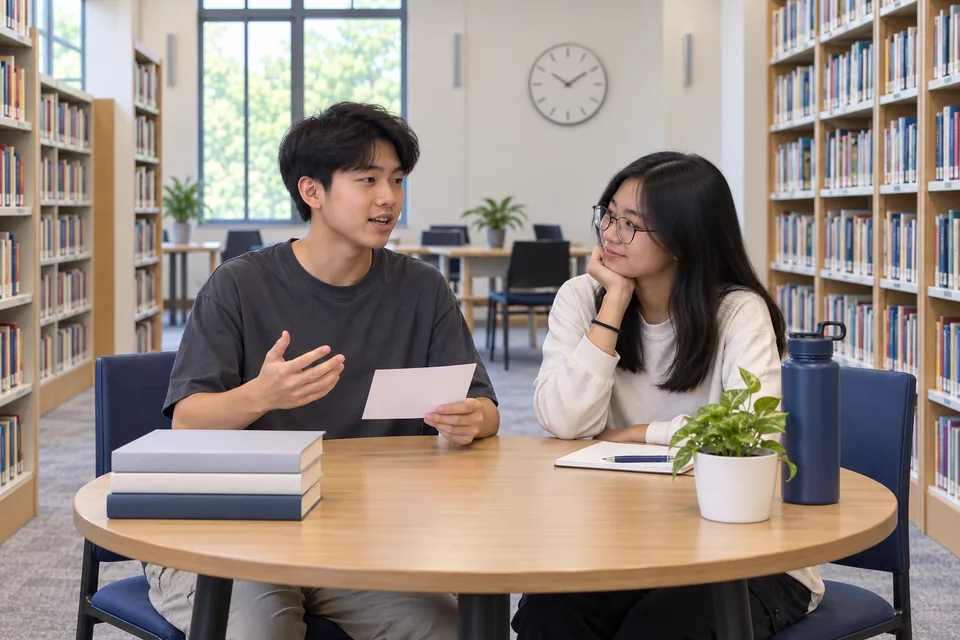
A session mirrors the test. The teacher sets a topic, and your child takes a short time to gather their thoughts and then speaks. The teacher listens as an examiner would, for structure, development, clarity and engagement.
The teacher then asks follow-up questions and pushes a point. This is where real skill shows.
Afterwards, the feedback is specific: where the opening worked, where a point was stated but not developed and how to handle the follow-up. We repeat the weak moment on a new topic, so the fix is practised.
If this question is on your mind, a paid one-hour trial with an experienced teacher is the simplest way to see how we teach.
Habits of a strong speaker
- Developing, not listing. Weaker speakers offer three quick opinions and stop. Stronger ones unfold one idea with reasons and an example.
- Answering the actual question. Examiners reward a student who thinks with them, not one who steers back to a prepared line.
- Controlled delivery. A well-placed pause beats a rushed sentence.
- Recovering gracefully. A student who pauses, gathers and continues sounds far more assured than one who panics.
Listening: a skill worth practising
Listening is harder than reading because it moves at its own pace and there is no going back. Students often answer on what they assumed was said, or catch the general idea and miss the specific point.
We practise it as its own skill. Your child holds detail across a passage, spots when a speaker qualifies an earlier point and answers on the evidence of what they heard. In the exam, this attention turns directly into marks.
Practice where mistakes are safe
In class, peers are watching. In the exam, an examiner is marking. Many students first try structured, spontaneous speech exactly when it counts most.
One-to-one online lessons change that. Your child can lose the thread, stop and try again with no audience. Each mistake becomes a specific lesson.
After a dozen unfamiliar topics, they walk into the component knowing they can cope. That confidence comes from practice, not from being told to relax.
Cost, scheduling and the trial
Lessons start from RM70 an hour. The rate depends on the teacher and level, and we confirm it on WhatsApp first. Lessons fit around school, and you pay by the hour with no packages.
The first lesson is a paid one-hour trial with the teacher who would continue. The teacher sets a topic, hears your child speak and shows a better way to structure it. We give honest feedback and steady practice, but we do not promise a grade.
What happens next
- Message us on WhatsApp with your child’s year, board and what worries them about speaking.
- We reply the same day, suggest a teacher and quote the rate.
- Your child takes the one-hour paid trial.
- Regular lessons begin if it suits.
Want to know our approach first? Read how we teach and our skills guides. When you are ready, Book a Trial Class.
One-hour paid trial · Same-day reply. If English is your child’s second language, see our guide on when English is a second language.