
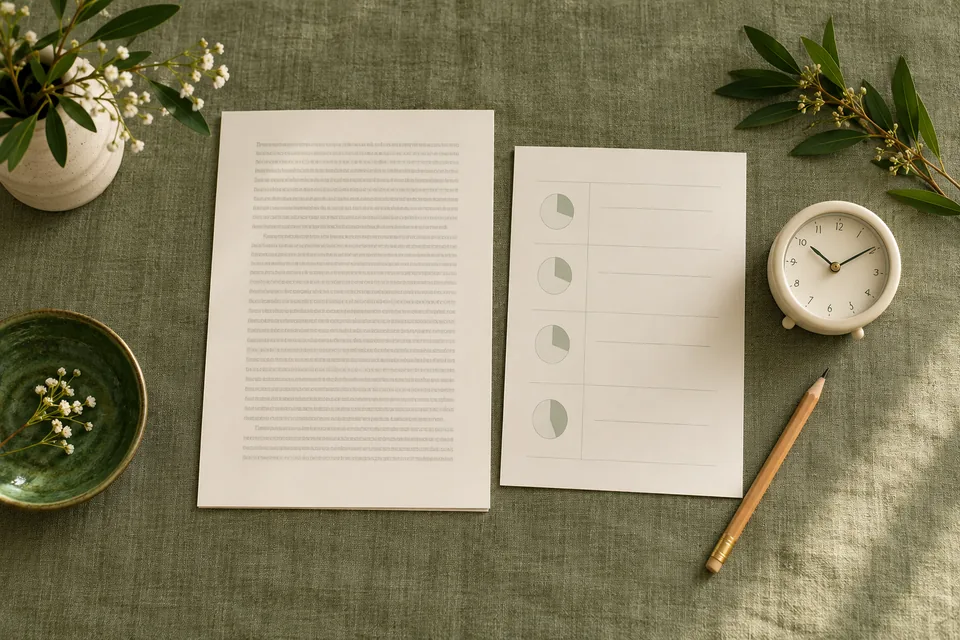
Split your time by marks, keep a short checking time, and do not let early questions use the minutes the harder ones need.
Where the time goes on the reading paper
Most students who lose marks on the reading paper do not lose them because the passage is too hard. They spend a lot of time on questions they enjoy, then reach the harder, higher-mark questions with little time left.
The first comprehension questions feel easy. A confident reader writes more than the answer needs, and takes minutes from the analysis and summary, which carry far more marks.
When the difficulty rises, the time has gone. The paper feels rushed, not because it was too long, but because the pacing was poor.
The number of questions, the marks and the length of the paper change by board and syllabus year. Check your board’s paper structure on our qualification pages. The idea is the same for all: your time is a budget, and it should follow the marks.
Split your time by the marks
Before you answer anything, turn the marks into a rough time plan. A question with a big share of the marks should get a big share of your time. A question asking for one detail should get almost none.
Use this routine:
- Glance over the whole paper and see where the heavy marks are.
- Give each low-mark question a short, firm time limit, and keep to it.
- Keep a short time at the end for checking. Treat it as time you cannot spend on writing.
If you protect these three things, the paper paces itself.
A worked example
Nadia sits a reading paper with a few short location questions, a longer analysis task and a summary.
Her first instinct is to answer the location questions beautifully, with full sentences and extra detail. Each one is worth very little, so every extra minute is taken from the analysis, which is worth much more.
A better way: she answers each low-mark question in as few words as the question allows. She does not explain a one-word answer.
She moves on the moment it is done. The minutes she saves go to the analysis and the summary.
She reaches the end with a few minutes left, reads back, and finds she answered a “how” question as if it were a “what”. She fixes it. That one fix, possible only because of good pacing, is worth more than all the polish she wanted to add to the easy questions.
This is easier to improve with a teacher beside you. A paid one-hour trial starts from your child's own recent work.
Common mistakes
- Over-writing the cheap questions. The time is taken from the questions worth more.
- Re-reading the whole passage for every question. After a close first read, later questions usually point to one part. Look there.
- Perfectionism. You rewrite one sentence three times while a question waits.
- Not knowing what “on time” means. Without a plan, you cannot tell if you are behind.
- Skipping the check because an answer feels unfinished. The check usually finds more marks than one more sentence.
How to practise
Pacing is a habit you can train. Take a past paper and, before you write, note a rough time for each section based on the marks. Then sit the paper against a clock.
Mark yourself on keeping to the plan, as well as on the answers. After a few papers, you will feel the point where you should stop and move on.
Also practise short answers alone. Give yourself a set of short questions and make each answer as short as is correct. Then practise the check on its own: read old answers only for misread questions, unfinished sentences and answers that drifted off the point.
How our teachers help
Students usually get stuck because they do not know where their time really goes. It is often not where they think. In 1-to-1 lessons, our teachers sit with the student through a timed reading paper and watch the clock with them.
They set time limits for the short questions, say when to move on, and mark the pacing as clearly as the answers. See our reading paper tuition.
Build the reading skill with our guide to reading for explicit meaning, then use the timed practice tasks. You may also like timing the writing paper.
If you want a teacher to look at your timing, book a paid one-hour trial. The teacher who would continue will watch you work through a timed section. Lessons start from RM70/hr, and we confirm the exact rate on WhatsApp.